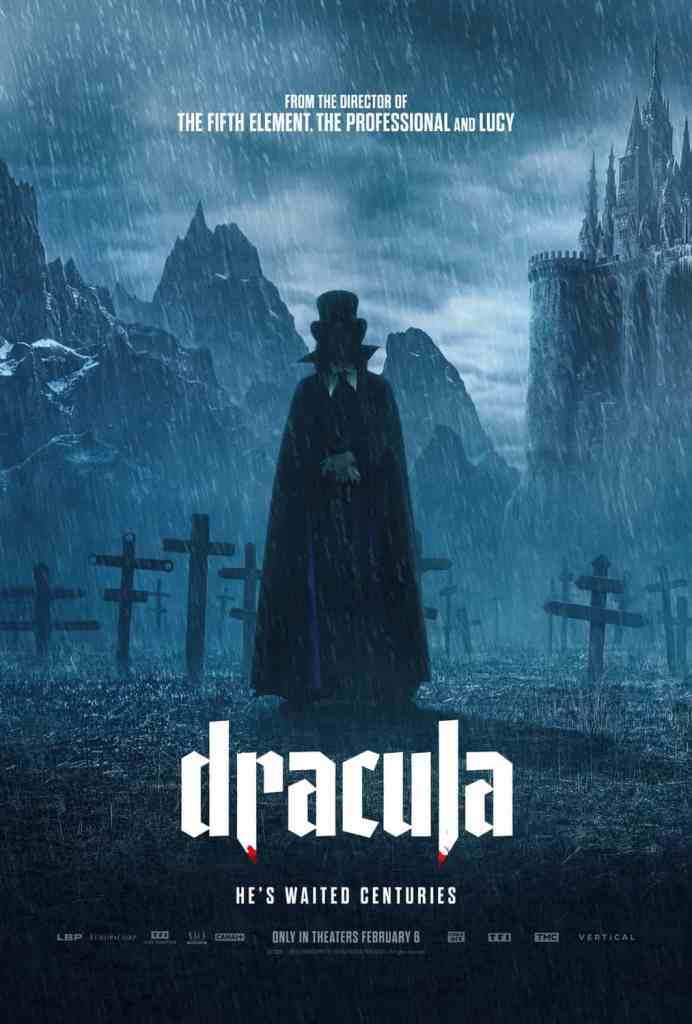
Last night I got current on my Dracula adaptations with Luc Besson’s Dracula (formerly known as Dracula: A Love Story.) How does it compare with those which have preceded it? Let’s take a look.
A Carpathian prince loses the love of his life, denounces God, then spends 400 years looking for his lost love’s reincarnation. Shenanigans ensue.
I heard things about this one so I went into it not expecting much. Which turned out to be the right attitude towards the film. Dracula is ripe for adaptation and new interpretation, so I didn’t slight Besson for moving many of the characters to France and setting the events during the 100-year anniversary of Bastille Day. I’ve seen poorer choices and the French setting didn’t have much of an impact on the story overall. What I do hold against Besson is lifting so much from Francis Ford Coppola. In fact, this film could have been called Luc Besson’s Francis Ford Coppola’s Dracula. When ancient-looking Dracula answers the door of his castle looking like he’s been holding Gary Oldman’s hairdresser and customer prisoner, my eyes did roll and I uttered an audible, “Really?”
I didn’t expect much of a horror film given the movie’s original title. It is, at its un-staked heart, a love story, after all. Leaning towards this genre rather than horror is likely the reason we get an awful subplot where Dracula spends centuries making the most alluring perfume on Earth. No, really. He uses the scent to entrance the female population of Europe in hopes his lost love will be attracted to him. Despite having telekinetic and pyrokinetic powers, I guess vampiric hypnosis was a bridge to far for Besson and a more mundane, yet outlandish, workaround was needed. Oh, and the perfume ends up having nothing to do with his eventual finding of his lost princess, so you be the judge if that part of the movie’s running time was well-spent.
The film is not devoid of pleasure. An inspired scene uses Dracula’s increasing treasury as a means to shorthand the passage of time and—spoilers—when Dracula finally perishes, having all the flames and fires in his castle go out was a nice touch. Christoph Waltz (playing “Priest”) delivers his usual greatness, but I fear he’s in danger of being typecast as the unconventional mentor figure. I had hoped for some excellent costuming and set design given what I assume was the film’s decent budget, and there are, but not enough by far. Oh, and Besson joins the parade of filmmakers guilty of Quincy Morris erasure. Goddamn it! Is it so hard to fit a cowboy into a vampire movie?!
Rating: It’s all been done better by others, meaning Dracula (2025) goes back to the grave with only 2-and-a-half skulls out of 5.
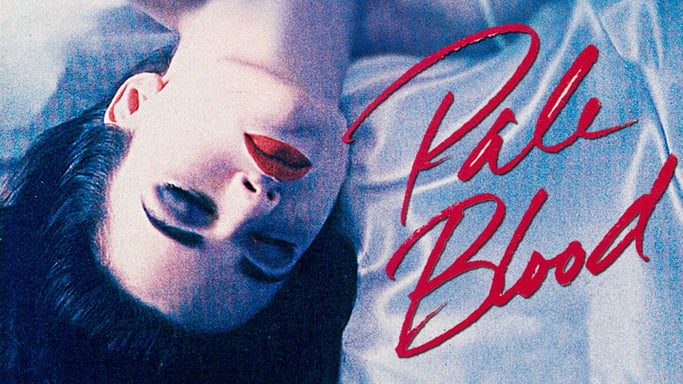
The late 80s and early 90s saw a boom in low-budget vampire movies featuring lovelorn vampires and the women attracted to them. Films such as To Sleep with a Vampire, Dance of the Damned, Tale of a Vampire, and, my personal favorite, To Die For. Day 6’s film (yes, I’m woefully behind right now) is part of that group—or perhaps, should I say, coven—of films.
Pale Blood is the tale of lonely vampire, Michael Fury (played by George Chakiris of West Side Story and the best “Mayan’s discovered Texas” film ever made, Kings of the Sun), who arrives in Los Angeles following news reports of a string of vampire murders in the city. Having recruited the assistance of private investigator, Lori (Pamela Ludwig), the search for the killer takes them into the orbit of video artist, Van (Wings Hauser) and his models who may be tied into the murders. Will Michael meet another vampire or become the victim of one?
If you’ve seen any of the vampire flicks I mentioned above, your enjoyment of Pale Blood will be dependent on whether you liked any of those. Pale Blood is cut from the same cloth, complete with nighttime L.A., neon lights, late 80s club scenes, and Wings Hauser. The most innovative idea is Michael’s portable coffin, a canvas suitcase that unfolds and is assembled like a tent (I’m going to steal that for a future vampire game!). Chakiris is game, but the role mostly has him being remote form the humans around him, including vampire fan Lori, who is clearly smitten with her employer. Scarily so. I’d have ended business with her on Night #2 if she was working for me. Nevertheless, I enjoyed Ludwig in the role, and I am a little sad she didn’t have more of a career.
There’s not much to see here, but as someone who lived in L.A. in the early 90s, the shots between scenes which are mostly Los Angeles during the day with radio station DJs’ commentary to fill the silence, were a trip down memory lane. And it gets bonus points for an appearance of the punk band Agent Orange as the house band at “Drac’s,” the nightclub featured in the film.
Ratings: Not great, but it has its charms if you lived through this era of low rent vampire romance films. I give it 2-and-a-half skulls out of 5, but deduc7 a ½ skull if you prefer more blood and less saxophones in your vampire films.
While I try to watch a movie each night, real life does gets in the way. I tend to get caught up on weekends, and the goal is to get through 31 by the end of Halloween, so do not worry if a day or three passes without a new movie review. With that said, let’s look at last night’s film.
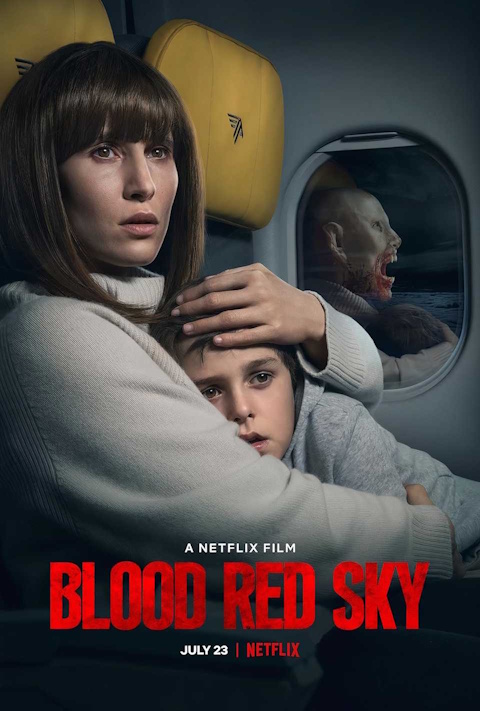
Blood Red Sky has an interesting and potentially fun premise: a woman suffering from a baffling blood disorder is on a transatlantic flight to America with her young son when their plane is hijacked. But the hijackers picked the wrong flight to commandeer. It’s with little surprise that we discover the woman is actually a vampire trying to hold onto her humanity for her son’s sake. But you can only push a vampire so far…
Blood Red Sky is a German production with an international cast. I’m unfamiliar with the work of Peri Baumeister who plays Nina, our vampire protagonist, but she does a wonderful job slowly becoming more and more animalistic as all her good intentions about holding on to her human nature start to slip once her son’s in danger. Alexander Scheer portrays our main antagonist, channeling Crispin Glover’s maniacal energy and sharing a not-dissimilar appearance. Dominic Purcell of Prison Break and Legends of Tomorrow fame has a supporting role as one of the hijackers, but feels underused. And speaking of underused, Graham McTavish has a glorified walk-on role that left me wanting more.
The film is more action than horror for most of its run time, but once Nina’s infection begins to spread throughout the passengers on the flight, we start veering into the airline sequence from World War Z, and the balance shifts towards gore and the horrific. By the end of the movie, one feels like this could be the prequel to The Strain.
The film’s biggest flaw is its 2-hour running time. Had it been shaved down to a tense 90 minutes, I feel it would have been a more effective story. Pacing was certainly an issue, but if you’re looking for an action/horror mix with some good physicality in its lead and a plot you could steal for a Night’s Black Agents campaign, you could do a lot worse.
Rating: With no major flaws, but also limited bits of true creativity, Blood Red Sky earns a middle-of-the-road 3 skulls out of 5.
I previously and somewhat cryptically alluded to the fact that I have Vampire: The Masquerade to thank for my current career. While that is true, my road from picking up that marble & rose cover book in 1991 and cashing my first paycheck as a game designer isn’t a direct one. There were lots of turns, temporary rest stops, and more the a few dead ends. Nevertheless, I could have quite easily found myself in another line of work had it not been for Vampire.
I was a TSR fanboy, having come into the role-playing hobby via D&D like so many others. At the time, roughly between 1980 and 1990, TSR games were the easiest to find in local hobby shops and toy stores. I played D&D, Top Secret, Gamma World, Star Frontiers, Marvel Super Heroes, and even the much maligned The Adventures of Indiana Jones. West End Games’ Star Wars and FASA’s Shadowrun both dropped as I entered my final years of high school and were a nice diversion from D&D, but we always drifted back to rolling d20s and killing monsters.
I graduated high school in 1990 and played in an AD&D campaign during my freshman year. It was fun, but not as fun as it had been in the past. Part of it was being an “adult” and on my own for the first time. There wasn’t a lack of opportunity for entertainment on a weekend or even a weekday night in college (and many of those opportunities also included beer and women), so the dew was off the RPG rose then. And doing anything for a decade is bound to get a little tiresome. I found myself seriously considering dropping RPGs as a hobby and doing something else for fun.
My time at the State University of New York came to an abrupt and unexpected ending in June of 1991. As it turns out, despite the fact I was paying the SUNY system, they still expected you to show up to class once in a while. MY GPA was in the toilet and the university suggested that I try something else—anything else—some place other than there. Much to parents’ dismay, I had been kicked out of college, but it was suggested that if I got my grades up, I could apply for readmission. In September of 1991, I enrolled in the local community college with hopes of returning to the SUNY system for the Spring ’92 semester.
I didn’t do any gaming while at community college, but I did pick up the occasional RPG book or issue of Dragon magazine. Old habits die hard, after all. One of those issues was the November ’91 issue (the same month as my 19th birthday), Dragon #175. That issue featured a Role-playing Reviews covering three horror RPG products: Dark Conspiracy, “Blood Brothers” (for Call of Cthulhu), and some game called Vampire: The Masquerade from a company I’d never heard of before.
I liked a good horror film or book, but I wasn’t particularly enamored of vampires. I had read Interview with a Vampire by then and had seen The Lost Boys and Fright Night, but was far from a fang fan. I was more of a ghost story guy. But, in the review, author Allen Varney summed up his piece with “If you’re up for a potent and even passionate role-playing experience, look for this game.” That stuck with me. Maybe my problem with RPGs was that my tastes had matured and I needed something more than killing orcs and taking their stuff? I promised myself I’d track down Vampire: The Masquerade and see how it delivered a potent and passionate experience.
The problem was I couldn’t find a copy. My friendly local game shop, Man at Arm Hobbies, did have a copy of Nightlife (co-written by Bradley McDevitt whom I now work with at Goodman Games). I liked Nightlife, especially since it was by default set in New York City (right in my backyard) and you could play a ghost (see previous paragraph), but it wasn’t quite what I’d hoped or was looking for.
Somehow, I eventually tracked down a copy of Vampire. It might have been on another trip to Man at Arms or maybe different store. And while I can’t remember where I bought it, I do remember where I read it for the first time. I was sitting in the dining room at my friend Carl’s house, flipping through the book. The opening in-world fiction written to Mina Murray from Dracula opened the floodgates of my imagination. This was something different. But the real moment that changed my life came on p. 36 in the section entitled “Automatic Success.”
In short, Vampire included the mechanic where if the number of dice in your dice pool equals or exceeds the difficulty of the task you need to perform, you automatically succeed. In other words, if the Difficulty is 5 and I have 6 dice in my dice pool, there’s no need to roll. Other RPGs had suggested you don’t need to roll to accomplish easy tasks anyone can do, but this was the first time I’d seen a mechanism that allowed you to succeed on things that might be challenging for the average person.
It’s been 34 years since I read that section and I still remember how much it blew my mind. That was the moment I stopped thinking of myself as a lapsed DM and as a potential Storyteller.
The rulebook only got better as I read it further. As a confirmed punk with music tastes that included Dead Kennedys, The Misfits, Black Flag, The Damned, The Exploited, etc., I found lyrics to songs I knew and loved leading off sections of the book. Hell, the entire milleu of the game was “Gothic-Punk.” It was almost as if these White Wolf folks were cool like me!
The former DuBois Hall where my ongoing Vampire chronicle began.
When January of ’92 rolled around, I’d gotten my GPA up and was welcomed back to SUNY New Paltz. I left all my D&D books at home when I packed for my trip back to the dorms. However, tucked into my back was my copy of Vampire: The Masquerade and a bag of d10s. I had big plans that semester, ones which ultimately led to a Vampire chronicle that lasted for years in different incarnations with different players, a chronicle that began on regular Sunday nights by candlelight in the now-former DuBois Residence Hall.
Vampire kept me in the hobby for another decade and made me rethink what you could do with a tabletop RPG. And while I did drift out of the hobby again for a time in the mid-2000s, the lessons I’d learned from V:tM stayed with me. I never again considered dropping the hobby for good and when I came back in 2008, I found myself on the path to becoming a freelance game designer and writer. Had it not been for discovering Vampire when I did, I know the odds of me returning to the hobby would have been slim and I might not currently have the job I do in the industry. Let’s just say I owe a boon to Vampire, in all its shapes and forms, and it’s a debt I’m happy to oblige.