Nostalgia is a razor that cuts both ways. It can be comforting, a way to remember the good times of the past, yet it is also looked upon with a measure of contempt. Reveling in nostalgia too much is a sure-fire way to be accused of living in the past at the cost of the present. But when the present is terrible, nostalgia can be a coping mechanism, a way to make it through the days, weeks, months, but hopefully not years, before the pendulum swings again and brighter times return.
I’ve been dwelling on the past more than usual these days. A minute of looking at the news or doomscrolling on social media and it becomes obvious why. Add all that to the fact I’ve now seen more than a half a century pass and it’s no wonder I’m in the midst of both a mid-life (more like two-thirds-life) and an existential crisis these days. I don’t feel quite like I’m drowning, but rather that I’m treading water and waiting for the next wave to roll. Throw in a little recent health scare and the nights can be long ones filled with a lot of reflection, self-recrimination, and wondering how and where it all went wrong.
I need a break from all that. I need to reminisce about the good old days a little and maybe, just maybe, get a trickle of dopamine from the brain spigot. Where to begin?
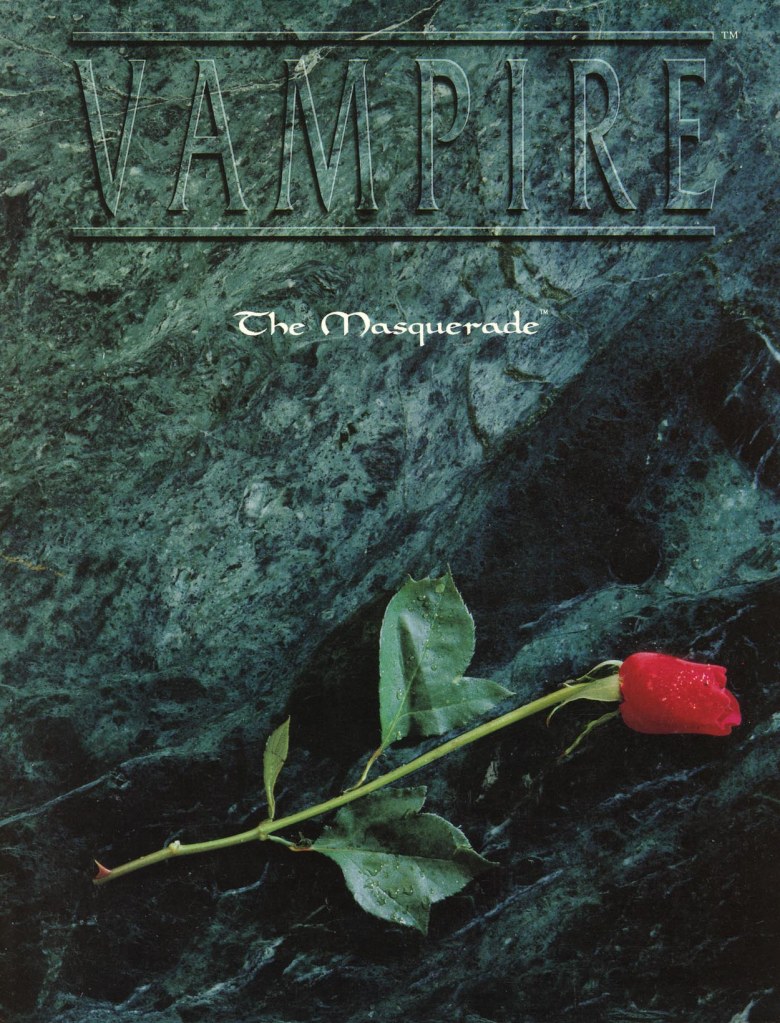
The answer, strangely enough, seems to lie in a more than 30-year-old tabletop RPG. One that was a titan at the time and changed the entire paradigm of the role-playing industry. A game that, laid the groundwork for my current career in the gaming industry. Not directly, mind you, but had it not come into my life at the time it did, I could easily see myself doing something else for both a living and as a recreational pastime.
That game is/was Vampire: The Masquerade, first published in 1991 by White Wolf. And say it arrived exactly when it was most needed and struck all the right cords in my heart, mind, and soul, is an understatement.
Those two sentences just made me feel both sides of nostalgia’s blade. Vampire: The Masquerade is associated with so many positive memories. The games, the music, the friends, the lovers, the times, the unrepeatable sense of power and possibility that lies in the heart of anyone in their 20s. Like a thread in the weave of my life back then, Vampire wove through everything.
And yet, there’s a sense of embarrassment writing about it right now as a soon to be 53-year-old man. Not for having played it or spent so much time thinking about it then and the memories that come from that time, but from that sense that I should have other concerns these days. Why spend a moment thinking about Vampire when there’s 401ks, my next doctor’s appointment, and making sure my professional responsibilities are met? The past is the past and there’s far too little future left to think about “back then” and pretending to be undead. I suppose it doesn’t help that vampires have lost a little of their luster in the post-Twilight and What We Do in the Shadows 21st century.
But you know what? I think I can work through all that. We can’t go home again, but we can cherish those memories. And I’ve learned the importance of making memories, especially shared ones. The worst thing about growing old is that the number of people who share our memories gets smaller every year. Death takes some, friends fall out of contact, and our individual priorities change. In our youth, we mocked the old codgers that sat around talking about the old days, but once you hit a certain point in your life, you realize how important that activity is. Roy Batty’s final words at the end of Blade Runner hit a lot harder when you’re in your 50s, unmarried, and without children. A time will come when you, and everything you’ve seen, done, and dreamed of, are gone. All that’s left, if you’re lucky, is a name on a stone and few dozen people to think about you from time to time—until they too are gone.

I’ve said many times over the past years that Vampire is the perfect game for when you’re in your 20s. You feel immortal and tragically hip then anyway (or at least I did), so you and the vampire have a lot in common. I’ve voiced that opinion enough that I think that’s yet another reason why I feel some embarrassment writing about the game now. It’s been at least a decade since I ran a session of Vampire and my players at that time were all in their 20s and 30s, and it’s been at least 6 or 7 years since I played, having sat in on a convention game shortly after the 5th edition came out to see how the new rules worked and what still felt like the old days.
Now I’m thinking I might be wrong about all that. Maybe there’s something just as pertinent to be wrought from a game of Vampire when age has begun seeping into your bones? Maybe the game can serve as a stage to enact new stories, ones with different themes than those from 1991? Maybe it’s still worthwhile to throw the occasional handful of d10s down on the table and see what happens next? My games were never the “trench coat and katana” kind, but I’m certainly more mature and have seen more horror today than when I was a college student sitting with my friends in a common area of a Dubois Residence Hall’s suite at SUNY New Paltz playing by candlelight.
Maybe it’s time to bury the embarrassment and try something I once loved again and see what other emotions can come from it? Worst case scenario is I waste a little of what time I have left. Best case? New memories and maybe some happiness during a time when that’s a precious commodity.
I started writing this essay with the intent of explaining myself to an audience, but now I realized that was an audience of one. This is me working out my complex feelings about a time I loved and miss more and more with each passing year or latest breaking development in the news cycle. This is not me explaining to you why I’m thinking about Vampire: The Masquerade on a summer afternoon a quarter of the way through the 21st century. It’s me giving myself permission to embrace the past and to do so without shame.
Having received permission, now all that remains is the doing. Best get started then. You can come along with me if you’d like. We might even make a memory or two together as we go.
 Shivers and Shudders